Grain composition and refractive indices
Pure materials
Dust (and ice) grains are described by indices of refraction, which are encapsulated within instances of the Material class. Material may be used to define the grain composition directly. There are a set of materials provided in the grains2.material sub-module:
>>> from grains2 import amcarbon
>>> ac = amcarbon()
>>> ac
<Material [amorphous carbon]>
>>> print("Bulk density: ", ac.rho, "g/cm3")
Bulk density: 1.5 g/cm3
Effective medium approximation
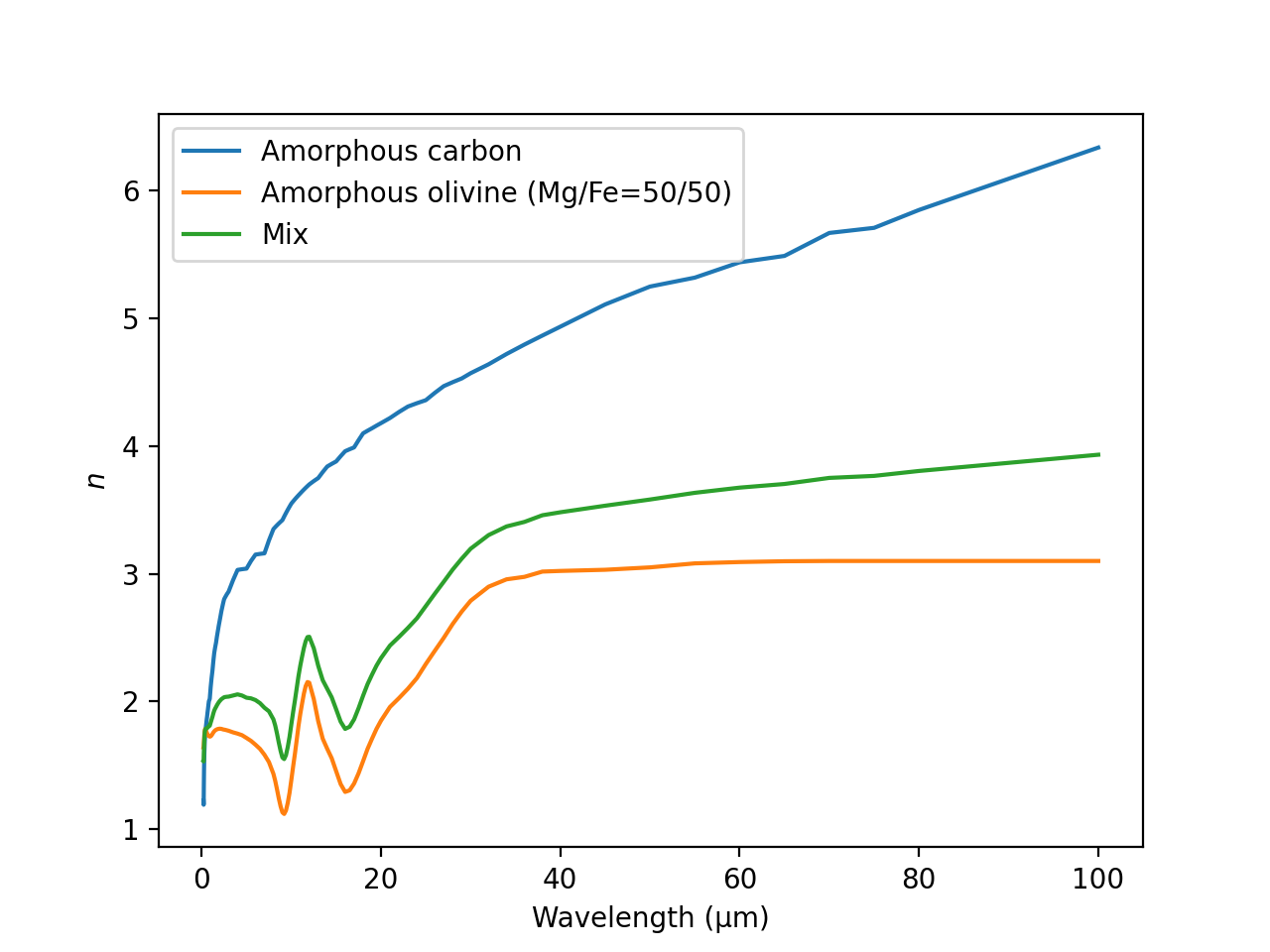
The effective medium approximation is a technique used to produce indices of refraction for a mixure of two materials and is commonly used in astronomy (Kolokolova et al. 2024, Comets III). grains2.ema includes the Bruggeman mixing rule. Create a mixutre of amorphous olivine (Mg/Fe=50/50) and amorphous carbon with a ratio of 1/3:
>>> from grains2 import Bruggeman, amolivine50
>>>
>>> ao50 = amolivine50()
>>> mix = Bruggeman.mix([ac, ao50], [1, 3])
>>> print("Bulk density: ", mix.rho, "g/cm3")
Bulk density: 2.85 g/cm3
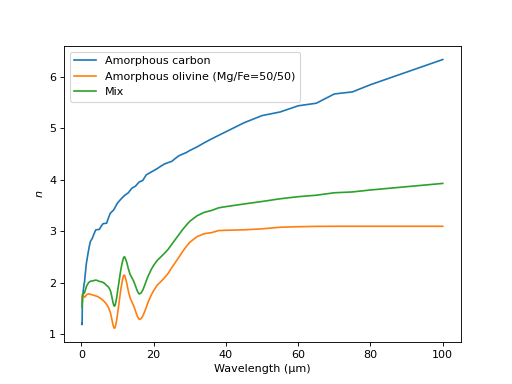
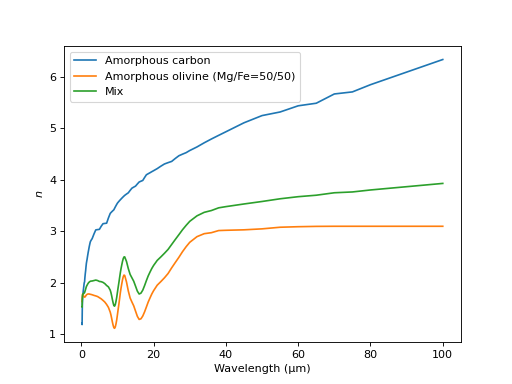
Plot the real part of the refractive indices:
(Source code, png, hires.png, pdf)